
What Is Doomjobbing — and Why Is It Sabotaging Your Career?
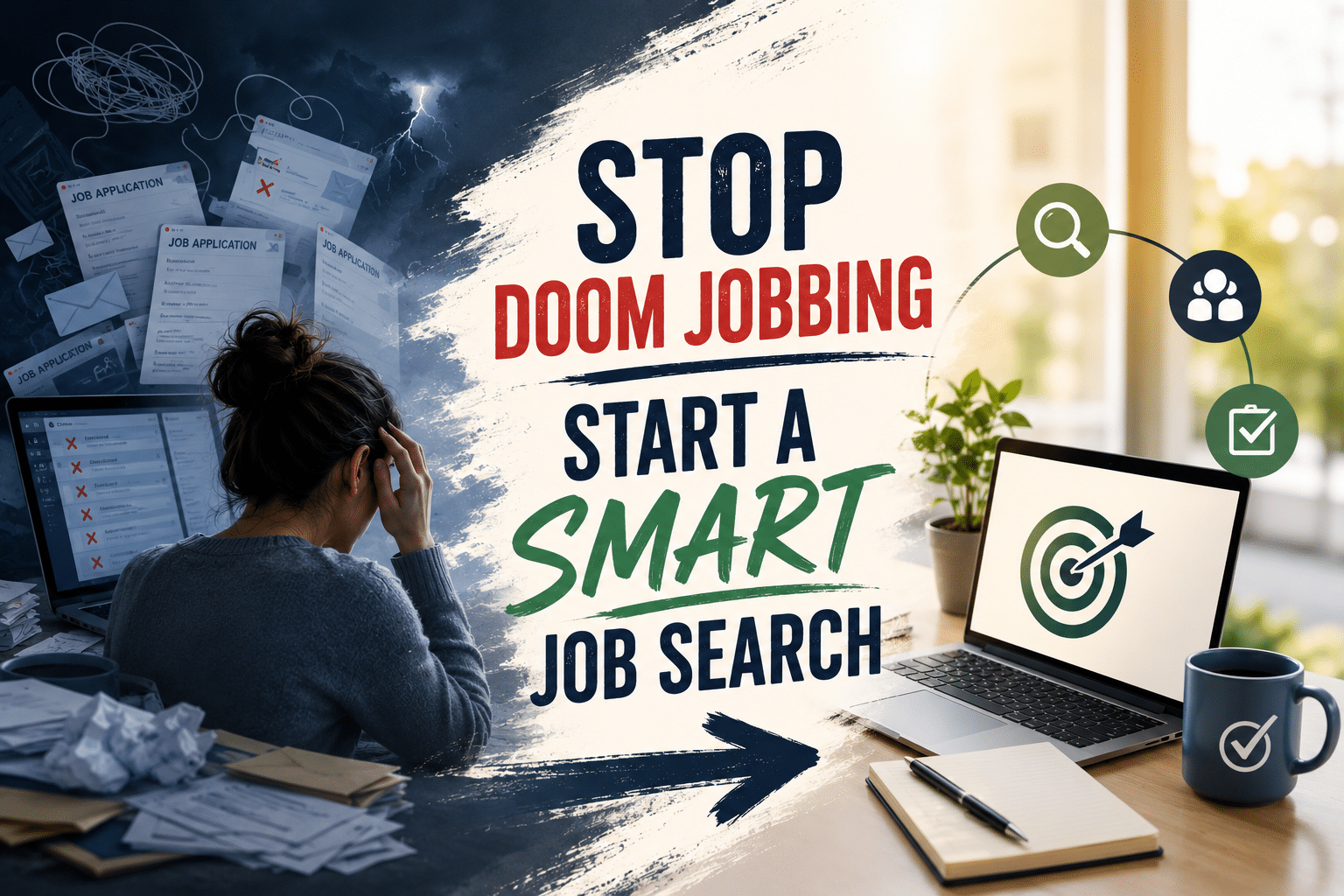
If you have ever spent an evening firing off a dozen job applications, closed your laptop feeling productive, and then heard nothing for weeks, you may already know what doomjobbing feels like — even if you did not have a name for it.
Doomjobbing is one of the most talked-about workplace trends of 2026. It affects job seekers across every industry. Moreover, experts warn that it can extend your job search by months. Understanding what it is — and how to stop — could be the most important career move you make this year.
What Is Doomjobbing?
Doomjobbing is the compulsive habit of mass-applying to jobs with little customization, focus, or intentional targeting. The term borrows from *doomscrolling* — the familiar habit of endlessly consuming negative news online. Just as doomscrolling feels productive while leaving you more anxious, doomjobbing mimics progress while quietly undermining your search.
Ben Shepherd, branch director with the global employment agency Robert Half, describes doomjobbing as “endlessly applying to a high volume of jobs with relatively low energy, low focus, and low personalization or detail.”
LinkedIn Career Expert Catherine Fisher says doomjobbing can also look like:
- Compulsively checking job boards throughout the day
- Applying to dozens of roles in a single sitting
- Using the same resume for every application
- Rushing through the outreach process without researching the employer
Career expert Shari Leid, a TEDx speaker and founder of the Flip the Box® Method for leadership, puts it plainly: “At its core, doomjobbing is often an emotional coping mechanism disguised as productivity.”
In May 2026, Cambridge Dictionary even asked on Instagram whether “doomjobbing” should become an official new word — a sign of just how widely the trend has taken hold.
Why Is Doomjobbing Happening Now?
The job market of 2025 and 2026 has not been kind to candidates. As a result, anxiety is driving behavior more than strategy.
The Numbers Tell a Difficult Story
According to data from Greenhouse reported by Business Insider, the average job opening in mid-2025 received **242 applications** — three times the average in 2017. At the same time, Bureau of Labor Statistics data shows that 1 in 4 unemployed workers have been searching for more than six months.
Gallup data makes the mood even clearer: just **28% of workers** say now is a good time to find a quality job. That figure has dropped dramatically from nearly 70% in mid-2022.
Employ’s 2025 Job Seeker Nation Report captures the emotional toll in two numbers: **70% of job seekers expect to land a role within 10 applications**, while **66% report feeling burned out** from the search. Expectations are high. Results are slow. The pressure pushes people further into the doomjobbing cycle.
Anxiety and a Confidence Gap
Nancy D’Onofrio, vice-president of strategic accounts with Randstad Canada, says the behavior stems from pressure rather than laziness. “There’s a lot of job market anxiety,” she explains, “and technology in the midst of that really makes it easy to submit.” People shift into a reactive mode instead of a proactive, strategic mindset.
A Randstad Workmonitor 2026 report — based on insights from more than 27,000 workers and 1,225 employers across 35 global markets — found a significant confidence gap: more than **9 in 10 employers** feel confident about their business growth this year, but only about **half of workers** feel the same. That imbalance drives volume-based searching.
AI Is Accelerating the Problem
Furthermore, artificial intelligence has made mass-applying easier than ever. Tools that auto-generate resumes and submit applications across multiple platforms allow candidates to apply to dozens of roles in a single sitting — often with minimal review of whether the opportunity is actually a good fit.
Why Doomjobbing Backfires
More applications should mean more chances, right? Not necessarily. In fact, research consistently shows the opposite.
Alexandra Tillo, senior talent marketing consultant at Indeed, says applying to dozens of roles in one sitting may “feel productive,” but “the quantity doesn’t always translate into results.” Candidates who spend little time tailoring applications or thinking critically about role fit often work harder while seeing fewer positive outcomes.
The employer side of the equation is equally important to understand. A Robert Half survey of 1,500 hiring managers in Canada found that **64% said the surge in AI-generated applications poses challenges** for their hiring process. When every resume looks the same because candidates used identical AI prompts, hiring teams spend more time screening — and less time giving serious consideration to any individual applicant.
Mismatched applications do not just waste time during the search. They can extend a job search by months, according to career professionals.
How to Break the Doomjobbing Cycle
The solution is not to work harder. It is to work differently. Here are four proven strategies to replace doomjobbing with a more effective approach.
- Shift from Volume to Relevance - Before you apply, ask yourself: Does this role actually work for you? Does the location, schedule, compensation, and long-term trajectory align with where you want to go? Tillo recommends evaluating fit before submitting rather than deciding later.
- Use AI Strategically — Not Just to Submit - Rather than using AI tools to blast applications, D’Onofrio suggests using them to research companies, understand their challenges, and identify where your skills would have the most impact. Then let that research inform a tailored, targeted application.
- Make Human Connections - Reaching out to hiring managers and employees through LinkedIn before or during the application process can help you stand out in ways that a resume alone cannot. As D’Onofrio explains: “It’s that human attribute, it’s that human skill, it’s that connection that hiring teams are looking to build — and that’s what’s going to set you apart.”
- Protect Your Energy and Confidence - Doomjobbing is exhausting. Taking breaks, stepping away from job boards occasionally, and setting a daily limit on applications can help you stay focused and avoid burnout. A smaller number of well-researched, well-targeted applications will almost always outperform a blizzard of generic ones.
A Word of Encouragement
If you recognize yourself in this pattern, know that doomjobbing is not a personal failure. It is a logical response to a genuinely difficult market — one shaped by economic uncertainty, AI-driven hiring tools, and record competition for open roles.
The problem is not your ambition, your experience, or your effort. It is the strategy. And that is something you can change today.
Sources
Sources: BNN Bloomberg / CTVNews.ca (June 2026), CNBC (May 2026), Yahoo Finance / Forbes (June 2026), HR Grapevine (June 2026), The Everygirl (June 2026), Randstad Workmonitor 2026, Employ Job Seeker Nation Report 2025, Gallup, Bureau of Labor Statistics

Achieve Your Goals with our Proven 3-Step Process
Schedule a Free, No Obligation Training Strategy Session.

Whether you're looking to switch careers or take the next step in your current career, our certified career coaches & strategists can help you explore a wide range of possibilities and learn how our training courses can help you reach your career goals.
Step 1
Strategy
Session
Uncover new IT and business career possibilities with a free training class strategy session.
Step 2
training
Classes
Start taking our expert-led, hands-on IT classes or business classes designed to drive career growth.
Step 3
Career
Coaching
Participate in our personalized career coaching program to achieve your development goals.
corporate headquarters
5005 N. Hesperides Street
Tampa, Florida 33614
(813) 947-0552

Please note: Not all courses on our site are under the purview of the Florida Commission for Independent Education (CIE) License 5831. Job placement assistance is available to all students. Individual results may vary.
Follow & Connect with Us

PMP® and CAPM® are registered marks of the Project Management Institute, Inc. Cisco and Microsoft are trademarks of their respective companies.
Copyright © Your Company. All Rights Reserved.